Why Early Lung Cancer Screening Matters
Lung cancer is often silent in its early stages. By the time symptoms such as persistent cough, chest pain, unexplained weight loss, or coughing up blood appear, the disease may already be advanced.
In Malaysia, this is a major concern. Lung cancer is the third most common cancer in the country, and nearly 95% of cases are detected only at Stage III or IV. The difference early detection makes is significant: when lung cancer is found at an early, localized stage, the five-year survival rate can be around 65%. Once it has spread, that rate may drop to about 8%.
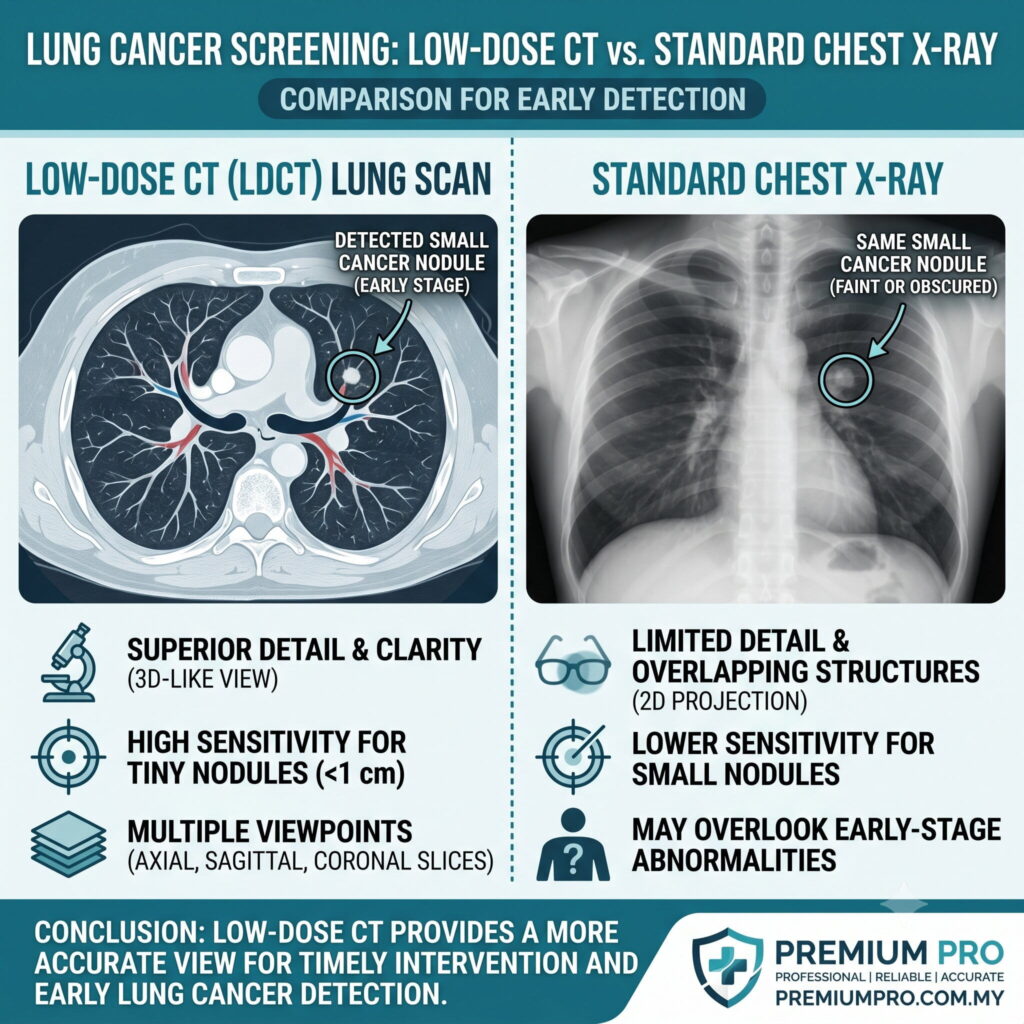
For years, many Malaysians have relied on a standard chest X-ray during annual health screenings. But for high-risk individuals, especially current or former smokers, a normal X-ray may create a false sense of security. Small lung nodules or early abnormalities can be hidden behind the ribs, heart, or other chest structures.
This is why Low-Dose Computed Tomography, or LDCT, has become the preferred screening option for high-risk individuals. Unlike a 2D chest X-ray, LDCT provides detailed cross-sectional images of the lungs, allowing doctors to detect smaller changes earlier.
For people in Johor Bahru who are at higher risk of lung cancer, understanding the difference between a chest X-ray and an LDCT lung scan may be a life-saving decision.
The X-Ray “Blind Spot”
Evidence from the National Comprehensive Cancer Network (NCCN) and the Department of Veterans Affairs (VA) is now definitive: standard chest X-rays are not recommended for lung cancer screening. The issue is one of “detail” and perspective.
A standard X-ray produces a flat, two-dimensional image. In this “snapshot,” small abnormalities can easily hide behind the heart, ribs, or the dense structures of the diaphragm. In contrast, LDCT uses helical (spiral) technology to take continuous images, creating thin 3D “slices” of the lung. This allows a radiologist to “see through” overlapping tissues that would otherwise create a dangerous blind spot.
“Participants who received LDCT scans had a 20% relative reduction of lung cancer mortality than participants who received standard chest x-rays.”
VHA Office of Integrated Veteran Care
What is a Low-Dose CT (LDCT) Scan?
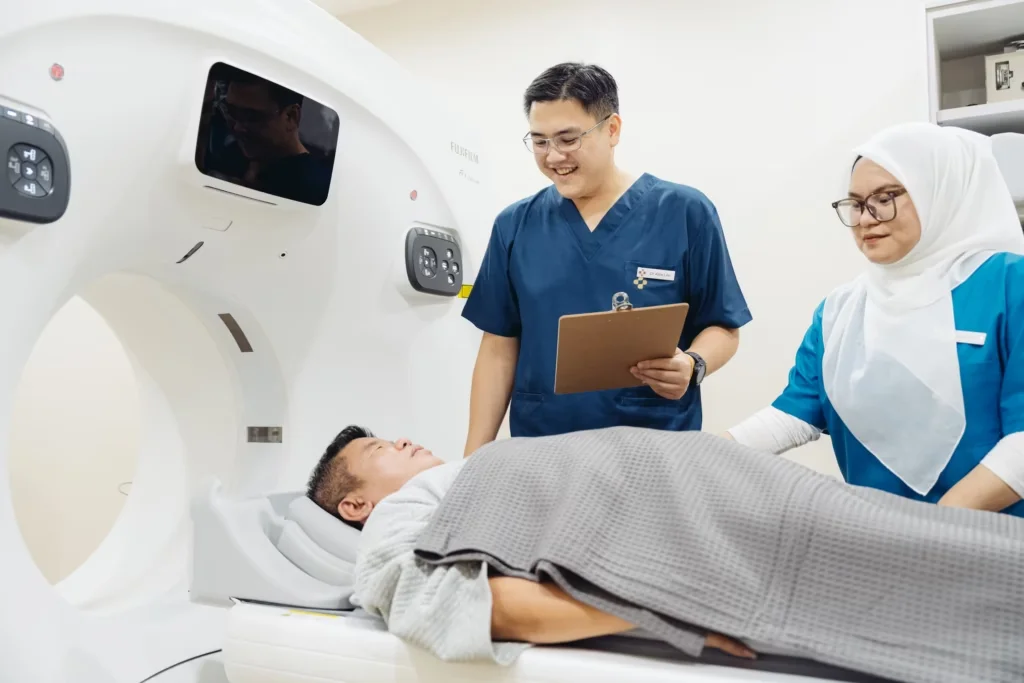
A Low-Dose Computed Tomography (LDCT) scan is a sophisticated imaging procedure that uses specialized X-ray equipment to create a series of detailed, 3-D cross-sectional “slices” of the lungs, while chest X-Ray is just 2D.
A major barrier for patients in Malaysia is “radiophobia”, the fear that the scan itself might cause harm. However, modern helical CT protocols have addressed this. “Low-dose” is a clinical reality: these scans use significantly less radiation than a diagnostic CT used for symptoms.
LDCT uses approximately 1/5th of the radiation of a standard diagnostic CT, roughly 70–85% less radiation . The actual scanning of the chest takes only 15 seconds. While the scan is fast, expect the total appointment to last 5 to 10 minutes to allow for positioning and preparation.
Comparison Table: LDCT vs. Chest X-Ray
| Feature | Chest X-Ray | Low-Dose CT (LDCT) |
| Technology | 2D / Static “Shadow” | 3D / Helical (Spiral) Slices |
| Detail Level | Low; nodules often hidden by bones/organs | High; provides multilayered and multiangle views of the whole chest |
| Early Detection | Poor; usually detects only late-stage masses | High; detects very small, early-stage nodules |
| Mortality Reduction | None proven for screening purposes | 20% relative reduction |
| Medical Recommendation | Not recommended for screening | The gold standard for high-risk individuals |
What to Expect During and After the Scan
During the Scan: You will lie on a table that moves through a large, tunnel-like machine. The process is painless and takes only minutes.
Note on the “Coughing” Instruction: In some cases, if a 1-month follow-up scan is needed to investigate a potential “endobronchial nodule” (a spot inside the breathing tubes), the technician may ask you to cough forcefully just before the scan. This helps us determine if the spot was simply a temporary plug of phlegm or a permanent nodule that requires a biopsy.
After the Scan: Findings are managed by a professional radiologist to translate complex imaging into actionable medical insights.
- If the scan is clear: You return for an annual screening in 12 months.
- If a nodule is found: Depending on its size and density, you may be scheduled for a follow-up scan in 1 to 6 months or further investigate with contrast CT scan or other modality.
Who Is Considered High Risk for Lung Cancer?
Lung cancer screening is not meant for everyone. It is most strongly recommended for people who are at higher risk, especially based on age and smoking history.
You may be considered high risk if you meet all of the following criteria:
- You are 50 to 80 years old
- You have a smoking history of at least 20 pack-years
- You currently smoke, or you have quit within the past 15 years
- You do not currently have symptoms such as persistent cough, chest pain, unexplained weight loss, or coughing up blood
A pack-year is a simple way to estimate lifetime smoking exposure. The formula is:
Packs smoked per day × Number of years smoked = Pack-years
For example, smoking 1 pack per day for 20 years equals 20 pack-years. Smoking 2 packs per day for 10 years also equals 20 pack-years.
For people who meet these criteria, many international guidelines recommend yearly Low-Dose CT (LDCT) screening, because LDCT can detect small lung abnormalities earlier than a standard chest X-ray.
What About Non-Smokers?
Although smoking remains the strongest risk factor, some non-smokers may still have a higher risk of lung cancer. These include people with:
- A close family history of lung cancer
- Chronic lung disease, such as COPD or emphysema
- Long-term exposure to second-hand smoke
- Occupational exposure to asbestos, silica, or other harmful particles
- Exposure to radon gas, air pollution, indoor coal or wood smoke, or frequent cooking fumes
For non-smokers, routine LDCT screening is not universally recommended in all guidelines. If you are a non-smoker but have strong risk factors, it is best to speak with a doctor or respiratory specialist for a personalised risk assessment.
How Often Should Screening Be Done?
For people who meet the typical high-risk smoking criteria, annual LDCT screening is generally recommended. The goal is to detect lung cancer at an earlier stage, before symptoms appear and while curative treatment may still be possible.
For selected non-smoking high-risk groups, such as those with a strong family history, screening frequency may differ depending on local medical guidelines and doctor assessment.
Accessing LDCT Screening in Johor Bahru
At Premium Pro, lung health screening is approached with early detection in mind. LDCT uses advanced CT imaging to produce detailed cross-sectional images of the lungs, allowing doctors to detect small nodules or suspicious changes that may not be visible on a normal X-ray.
Premium Pro Healthcare Centre
53 & 55, Jalan Mutiara Emas 10/2,
Taman Mount Austin,
81100 Johor Bahru, Johor Darul Ta’zim
018-762 8355
Conclusion: Early Detection Changes the Conversation
Lung cancer is often diagnosed late because early-stage disease may not cause obvious symptoms. This is why proactive screening matters.
The shift from standard chest X-ray to LDCT is not just about using newer technology. It is about giving high-risk individuals a better chance of detecting lung cancer earlier, when treatment options may be more effective.
Medically Responsible Disclaimer: Screening is a vital tool, but it is not a “license to smoke.” Quitting smoking remains the single most effective way to reduce your risk of lung cancer and improve your overall health.
Frequently Asked Questions (FAQ)
Does the scan require needles or dyes?
No. An LDCT screening scan is entirely non-invasive. No needles, injections, or contrast dyes are typically required for the initial screening.
How long does it take?
The scan itself is remarkably fast, taking only 5 to 15 seconds. You will simply be asked to lie still and hold your breath for a few moments.
Should non-smokers be screened?
Standard guidelines do not recommend screening for non-smokers unless they have specific, significant additional risk factors. If you are concerned due to family history or environmental exposure, please consult our specialist for a personalized risk assessment.
Reference:
https://www.jto.org/article/S1556-0864(19)33639-1/fulltext
https://www.healthline.com/health/lung-cancer-stages-survival-rates
de Koning et al., NEJM 2020 (NELSON); Lung Cancer Network Malaysia CPG 2025 (lungcancer.net.my)